Consumer Goods Technology (website here) has published good insights on what are going to be the drivers for the next wave of consumer innovation in products and services in the article "Top 3 Innovation Drivers Revealed" here. Highlights from the article:
"Economic Blues: History shows that when the economy stumbles badly, entrepreneurs use this as an opportunity to create "engines of change." During the Panic of 1907, for instance, Henry Ford redefined how manufacturing was done by devising a far more efficient assembly line process..."
"Boomer Influence: While all forms of media continue to demonstrate a bias toward youth, the facts of the aging baby boomers tell a different story about economic influence, growing healthcare issues, lifestyle changes and generational transfer of wealth. In America alone, 76 million baby boomers have an annual spending power of $2 trillion..."
"A Greener World: The 19th century was powered by coal, and the 20th century was powered by oil. Recognition of what past and current human behaviors are doing to our planet have us now moving into an era that will be powered by the sun, the wind, wave motion and renewable energies..."

Tuesday, March 31, 2009


Personal Care Growth in Russia
SCA, a EUR 11.5b Swedish consumer product goods company (details here), has expanded its Russian personal care consumer products business successfully, see details here. On the same page, a good visual allows a quick browse of SCA's 2008 quarterly reports and highlights. Interesting to note is that SCA net profits grew 4% in 2008.
Consumer Electronics - Nokia Wins in China
From the China Daily article "Nokia signs $1.76b phones deal in China" here. Article states:
"Nokia has signed a 2009 framework deal worth $1.76 billion to supply handsets in China for top phone distributor China PTAC, with the annual contract's value falling from the year ago."
What is interesting to note is that China produces large quantities of off-brand, generic mobile phones that are sold across South and South East Asia, Middle East and Africa. Yet, the quality associated with a brand such as Nokia is winning with the consumer.
"Nokia has signed a 2009 framework deal worth $1.76 billion to supply handsets in China for top phone distributor China PTAC, with the annual contract's value falling from the year ago."
What is interesting to note is that China produces large quantities of off-brand, generic mobile phones that are sold across South and South East Asia, Middle East and Africa. Yet, the quality associated with a brand such as Nokia is winning with the consumer.
Monday, March 30, 2009
Usability - "Universal Design" Through Human Factors Science
During a recent lecture visit to Georgia Institute of Technology I had a chance to catch up on the ever growing group - The Center for Assistive Technology & Environmental Access (CATEA), see details here. Even though the mission of the center is driven to explore accessibility for disabled or handicapped individuals to consumer products and their ease of use - the center has employed "human factors" design and engineering approach that focuses on the interface between humans and machines. Products studied have included everything from photocopiers, mobile phones, and TVs to medicine bottles, printers and scanners.
An outcome of the efforts has been "universal design" intended to make a product accessible to as many different types of users as possible. For example, a mobile phone may have a specific function for people who are hard of hearing. Yet, this is useful for anyone trying to carry on a mobile phone conversation in a noisy environment. Another example is a mobile phone designed for the blind - it could be useful for individuals whose visual attention is focused elsewhere, such as while driving a car.
I learned and practiced the science of human factors with probably some of the best in the industry at the AT&T (then NCR) Human Interface Technology Center (HITC), folks such as Dr. Mark and Nong Tarlton, Dr. Richard Henneman and Dr. Tom MacTavish. Here is a short abstract on HITC:
"The NCR Human Interface Technology Center (HITC) exists to meet its customers' business needs through the application of new human-interface technologies. The HITC designs and develops these user-interface solutions through a user-centered design (UCD) process, in which user needs and expectations guide all design and development decisions. The HITC consists of about 90 engineers and scientists with expertise in such areas as cognitive engineering, graphic design, image understanding, artificial intelligence, intelligent tutoring, database mining, and new I/O technologies. Established in 1988, the HITC is funded by work performed for its customers."
Absolutely way ahead of its time, HITC was the place where research met or tried to meet the commercial world. I was engaged in a National Institute of Science and Technology (NIST) project “Information Infrastructure for Healthcare” – details here.
I am reminded of Steve Jobs statement - "It's really hard to design products by focus groups. A lot of times, people don't know what they want until you show it to them." This was how we conducted our business at HITC!
An outcome of the efforts has been "universal design" intended to make a product accessible to as many different types of users as possible. For example, a mobile phone may have a specific function for people who are hard of hearing. Yet, this is useful for anyone trying to carry on a mobile phone conversation in a noisy environment. Another example is a mobile phone designed for the blind - it could be useful for individuals whose visual attention is focused elsewhere, such as while driving a car.
I learned and practiced the science of human factors with probably some of the best in the industry at the AT&T (then NCR) Human Interface Technology Center (HITC), folks such as Dr. Mark and Nong Tarlton, Dr. Richard Henneman and Dr. Tom MacTavish. Here is a short abstract on HITC:
"The NCR Human Interface Technology Center (HITC) exists to meet its customers' business needs through the application of new human-interface technologies. The HITC designs and develops these user-interface solutions through a user-centered design (UCD) process, in which user needs and expectations guide all design and development decisions. The HITC consists of about 90 engineers and scientists with expertise in such areas as cognitive engineering, graphic design, image understanding, artificial intelligence, intelligent tutoring, database mining, and new I/O technologies. Established in 1988, the HITC is funded by work performed for its customers."
Absolutely way ahead of its time, HITC was the place where research met or tried to meet the commercial world. I was engaged in a National Institute of Science and Technology (NIST) project “Information Infrastructure for Healthcare” – details here.
I am reminded of Steve Jobs statement - "It's really hard to design products by focus groups. A lot of times, people don't know what they want until you show it to them." This was how we conducted our business at HITC!
Sunday, March 29, 2009
World's Largest Retailer Pays Bonuses
In business news this week - "Wal-Mart paid out $933.6m in bonuses to 1m of its workers. The retailer has not had to ask for government assistance."
Monday, March 23, 2009
China's Silicon Valley - National Innovation Zone
From colleague Mr. Tony Tsai, Chief Executive Officer – BHG Retail Innovation Institute & Executive VP Operations – The BJ Hualian Hypermarket Co. from China:
"The State Council has reached a decision to back the building of a national independent innovation demonstration zone in the Zhongguancun Science Park (Z-Park) in Beijing, said Minister of Science and Technology Wan Gang Friday. Some Chinese people like to call the Z-Park "China's Silicon Valley".
See details on the innovation center here.
Read about the Zhongguancun Science Park (Z-Park) here.
Sunday, March 22, 2009
Investment in Chinese Firms Sags
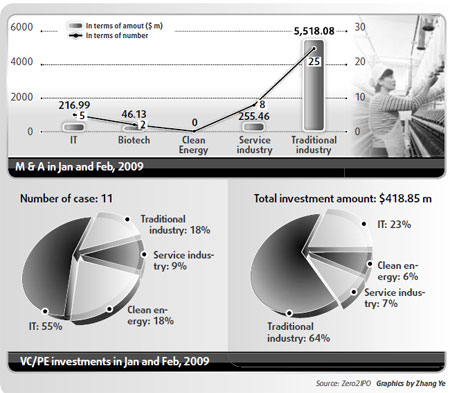
From the China Daily, see complete article here:
"Private equity and venture capital firms have invested about $419 million in 11 companies in China over January and February, said the report. They invested $3.62 billion in 152 companies in China in the first quarter last year."
World Perspective / Photo - 5 [Education]
 Taking metric (equivalent of class 10 or 10th grade) examination on the premises of Peshawer University, Pakistan. Candle lights are lit as the power outages are often and unplanned, lasting 12 hours or more in a day.
 Below, students of a local school in Swat, Pakistan solve their examination papers in the debris of their school. The school was destroyed during fighting between the Pakisani military and insurgents.

Friday, March 20, 2009
Global Recession
BBC has created an interesting site dedicated to the world's current economic condition called "Global Recesion" here. It an interesting mix of business and financial news on the world-wide recession while being an interesting mix of news on almost all major sectors from manufacturing to BPO, impact on individuals to nations and regions, with good analysis on the events of the day.
South Asian Leadership's Internet Presence
BBC assesses the quality of South Asian political leadership's web presence in "Which S Asian leader has best website?" here. Couple of interesting surprises.
Consumer Insight - Skin Color: White or Tan?
I have been following Philip Martin's "The Color Initiative" (details here) with interest. Two recent podcasts have provided Asian consumer insights of great value.
 Traditionally, from the Far East and South East Asia to South Asia and Middle East, white skin color is prized, darker color has been associated with lower cast or class, implication of an individual's socio-economic standing, etc. Interestingly these influences date back not just centuries but millennia.
To highlight this point, in the podcast a Taiwanese 18 year old girl states:
"I try hard to make my skin white, yes. If my skin is lighter, I think I will be more happier."
Philip Martin states of the skin whitening business:
"Across Asia, skin whitening is a growing and lucrative $18 billion dollar industry. Cosmetic companies and dermatologists are scrambling to cash in – pushing whitening creams, ointments, and skin-bleaching treatments."
Listen to the podcast or read the transcript for "Skin whitening big business in Asia" here.
Next Philip Martin provides a contrarian view that the consumer is choosing to act on from within the same region in the podcast "The color of success in Asia" here.
These two podcasts highlight that a tradition within a culture can have long lasting affects. With economic growth and independence, the consumer can choose to shed the burden of tradition in favor of another choice available to them. The Asian consumer is going to be evolving at a fast pace and the traditional CPG companies engaged specifically in beauty-care may need to look upon this business as FMCG.
Innovations from Developing Nations
An article from Fast Company "How Innovations from Developing Nations Trickle-Up to the West" here by way of Mr. Karthik Meda. The article states:
"Innovation has always been about people in rich nations getting the latest stuff and the rest of the world getting our castoffs as our markets scale and prices come down."
The above statement highlights the narrow approach to thinking about innovation. The above statement may not be wholly correct, and a few of my friends living and working in the developing worlds may just simply smile at the above observation and shake their heads.
I believe the article may have been a good read, say ... 15 years ago. Multi-Nationals recognized these aspects ages ago, built innovation centers in the regions where the creativity was needed and delivered to the consumer. Please search my blog for a plethora of global examples of innovation delivering on the need from the developing world.
Overall, the article disappoints.
Subscribe to:
Posts (Atom)