Showing posts with label investment. Show all posts

Tuesday, September 21, 2010

Organizational Transformation in the Financial Sector Due to HFT

"The rapid-fire growth of high-frequency trading, HFT, has spawned a new breed of market mavens whose backgrounds are far different than the traditional suit-clad Wall Street titans.  Their resumes are rich in rocket science and other non-financial fields and they may never have traded a stock, read an earnings report or scrutinized a balance sheet.  They are engineers, mathematicians and computer scientists—armed with cutting-edge technology and often located hundreds of miles from New York City."

Mr. Dharm Kapadia forwards an excellent article on a trend that is rapidly becoming mainstream in the financial sector holistically, see "Man Vs. Machine: The New Kings Of Wall Street" at CNBC here.  Please see my previous post on high frequency trading "Dis-ruptive Innovations - Technology in Retail Investment Sector" here.

Thursday, September 9, 2010

Dis-ruptive Innovations - Technology in Retail Investment Sector

The Financial Times published a well thought through analysis on high-frequency trading and its impact on traditional and retail investors here... William Gibson's quote could be used to summarize the essence of HFT: "the future is already here, it's just not very evenly distributed".

Wikipedia defines HFT as - "High-frequency trading is the execution of computerized trading strategies characterized by extremely short position-holding periods".  Computerized strategies implies simple to complex algorithms and extremely short positions can mean micro seconds to ones that are never executed but are noise generators.

A quote from Kevin Cronin, Head of Equity Trading at Invesco stated: "Because of the predatory nature of some participants we have no incentive to post liquidity,” ... “There are 40 places where stocks are transacted and none of us has clarity of supply and demand on most [equity] issues. These are fundamental issues as to what the value of a securities market is".

Mr. Dharm Kapadia, who has advised The RBR Group (my company) on technology in the financial sector explained that:

"Inexpensive co-location has facilitated the growth of high-frequency trading (HFT) and will continue to support it in the future as computers and networks will only get faster. The individuals participating in HFT not only take on, and beat the big players, but also evade the regulatory agencies. All you can see is their "vapor trails" in the historical trade and quote data. The retail investor is miles behind the HFT participant; they're not normally going to get the best execution in this type of environment. Ubiquitous technology will allow the HFT trader to be faster, more nimble, and hard to trace."

Of course, within this macro-trend of explosive growth of HFT - the democratization of technology, and its power and speed will enable the astute fund management companies in retail investments to begin constructing a premier service that will become consumer grade in this coming decade.  And the first one of these services to market will generate aggressive premiums prior to the arrival of competition.

Interestingly today the Financial Times front page includes the article "High-frequency trades earn fine" here.  Excerpt from the article:

"US regulators are to fine a high-frequency trading firm, signalling sharper scrutiny of this type of activity, amid a broader crackdown on market abuse following the May 6 “flash crash”.

The enforcement action, brought against a small New York firm for “layering”, will be settled on Monday with the payment of about $2.3m in fines and disgorgement penalties, according to people familiar with the situation.

Layering involves traders entering multiple fictitious orders, which are then cancelled within seconds. The strategy is used to drive a stock price up or down, before using a real order to profit from the artificially inflated or depressed price.

It is one of the high-frequency trading techniques – alongside “spoofing”, in which traders feign interest in stocks to drive the price up or down – that some believe may have played a part in the 20-minute period of wild price gyrations on May 6 known as the “flash crash”.
"

Wednesday, April 28, 2010

Mohamed El-Erian

Mr. Mohamed El-Erian, CEO of PIMCO is someone I have listened to closely when it comes to understanding investments in global markets.

"As a group emerging markets have become stabilizers in the system, old days we thought of them a disruptor."

See the video here.

Monday, April 19, 2010

Jeremy Grantham on Financial Bubbles - Excellent!

Jeremy Grantham states - "Bernake has happily picked up the mantle, and seems totally unconcerned about creating another bubble.  He has got interest rates so low, banks can't possibly not make a fortune, savers are being penalized, anyone who wants to buy cash faces a painful experience... so we are all tempted into speculating, which is apparently what he wants and we have just had one of the great speculative rallies in history second only to 1932-33."  Watch the complete interview here.

Thursday, August 6, 2009

Stephen Roach: I'm starting to worry about China's economy

Via Mr. Tony Tsai, CEO – BHG Retail Innovation Institute and EVP Operations – The BJ Hualian Hypermarket Co.:

"This is an article written by Stephen Roach, chairman of Morgan Stanley Asia, which is posted on the website of the Financial Times. Its original title is "I've been an optimist on China. But I‘m starting to worry". On the surface, China appears to be leading the world from recession to recovery. After coming to a virtual standstill in late 2008, at least as measured quarter-to-quarter, economic growth accelerated sharply in spring 2009. A back-of-the envelope calculation suggests China may have accounted for as much as 2% of annualized growth in inflation-adjusted world output in the second quarter of 2009. With contractions moderating elsewhere, China's rebound may have been enough in and of itself to allow the global gross domestic product to eke out a small positive gain for the first time since last summer.That's the good news. The bad news is that China's recent growth spurt comes at a steep price. Fearful that its recent economic short- fall would deepen, Chinese policymakers have opted for quantity over quality in setting the macro-strategy, the centrepiece of which is an enormous surge in infrastructure spending funded by a burst of bank lending. A macro strategy that exacerbates troubling imbalances is ultimately a recipe for failure. In many respects, that's what the global crisis and the recession of 2008-09 are all about. China will not get special dispensation from the most critical lesson of this post-crisis era."

See the complete article here.

Sunday, March 22, 2009

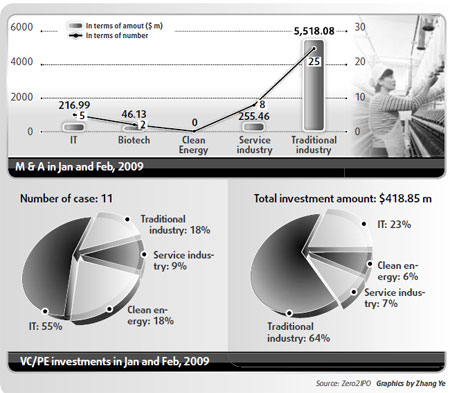
Investment in Chinese Firms Sags

From the China Daily, see complete article here:

"Private equity and venture capital firms have invested about $419 million in 11 companies in China over January and February, said the report. They invested $3.62 billion in 152 companies in China in the first quarter last year."

Monday, March 9, 2009

China Investing in Europe

China is on to its second round of investments in Europe. An excerpt from The American Chamber of Commerce in the People's Republic of China news article "Business delegation of over 20 Chinese enterprises flies to Europe for investment":

"March 7, another Chinese delegation comprised of businesses and industry leaders led by the Ministry of Commerce leaves to visit four European countries for investment and economic cooperation. The delegation is heading for Germany, Switzerland, Spain and Britain. The new delegation will explore investment opportunities in the areas of automobiles, machinery, textile, food, electronics and energy-conservation and environmental protection technologies. The delegation is composed of more than 20 top Chinese companies as well as several national trade associations and government officials."

A recent visit by a Chinese delegation is covered in the article "China spends $10b in Germany" here which states:

"Feb. 25-26, Minister of Commerce Chen Deming leads a business delegation to pay a visit to Germany and Switzerland. A total of 36 procurement contracts worth of more than $10b are signed between Chinese and German companies on Feb. 25. The Chinese business delegation arrives in Switzerland on Feb. 26. The two countries sign a Memorandum of Understanding to boost joint work in energy saving, environmental protection and trade & economy. In addition, the Chinese business delegation inks trade deals worth more than $300m with Swiss companies, such as ABB and Holcim for technical software, advanced electrical equipment, metals and raw materials."

Friday, July 11, 2008

Frontier Markets

A new kind of market awaits the hype cycle and inflow of capital - the Frontier markets. Developed, developing, emerging, emerged... now Frontier!

The BRIC (Brazil, Russia, India, China) financial markets are now fluctuating with theUS markets and in some cases their peaks and valleys seem to have a larger spike and dip, respectively. Having seen the growth numbers of some of the BRIC countries, I have to confess I do find myself scratching my head because their is no reason for those markets to fluctuate like the US, perhaps some... but by no means go to the extremes. Here (2007 Report to Congress of the U.S.-China Economic and Security Review Commision) is an interesting read that may shed light on my head scratching.

In comparison, the Frontier markets such as Middle East (a few Gulf region nations and Israel), Africa (South Africa, Eqypt, Morocco) seem to be holding their own. I predict that soon the financial media outlets and the investment analysts will be touting the unprecedented growth to be had from the Frontier markets and we will see a mass exodus of funds from the BRIC equity markets and other retail investment vehicles.

I will restrain myself from giving specific examples, yet as proof I guide the reader to look at ETFs and Mutual Funds portfolios built of the Frontier countries mentioned above and compare to the DOW Industrial Ave. The strength will be obvious.